
PolarRES introduces Polar Storyline Lens
1 December 2025
PolarRES has completed its four year programme to improve understanding of how rapid changes in the Arctic and Antarctic shape the global climate system. The project now presents its final digital resource: an interactive visual tool that lets users explore projected climate changes across both Polar Regions.
Advancing knowledge of Polar change
Over the past four years, the Horizon 2020 project has conducted breakthrough research on the interactions between the atmosphere, oceans and sea ice in the Arctic and Antarctic, while also working to communicate what this means for society and the environment.
As part of this effort, PolarRES introduced a suite of digital resources:
- Polar Panorama – an interactive showcase of personal perspectives on the vulnerability and protection efforts of the Polar Regions
- PolarRES in Practice Stories – short, accessible summaries explaining project findings and their significance
- Polar (change) Explorer – an interactive infographic that illustrates key atmospheric, oceanic and cryospheric processes.
Introducing the Polar Storyline Lens
The project now releases its final tool: the Polar Storyline Lens. This interactive tool allows users to examine how different climate variables could change in the Arctic and Antarctic by choosing from various models, emissions scenarios, regions and time frames.
Explanation of variables and options
Variables
PR
Total precipitation from rain and snow.
SNC
Snow cover area at the surface.
TAS
Near surface air temperature.
Scenario
Historical
Past climate reference (1985 to 2014).
SSP3 7.0
High emissions future scenario.
Evaluation (ERA5)
Model run driven by reanalysis to assess performance.
Domain
Atmospheric
Air and weather processes.
Oceanic
Ocean conditions.
Ice
Cryospheric processes.
Forcing Model
CNRM
Global model providing boundary conditions from the CNRM ESM2 1 system.
NorESM MM
Global model from the Norwegian Earth System Model framework.
ERA5
Reanalysis dataset combining observations and model data.
Period
Near term
2026 to 2055.
Long term
2070 to 2099.
Historical
1985 to 2014.
Present
2000 to 2020.
Value or Difference
Value
Absolute value of the variable.
Difference
Change compared with the 1985 to 2014 baseline.
Grounded in the storyline approach developed by PolarRES, the Polar Storyline Lens presents map based outputs that show how shifts in large scale atmospheric and oceanic circulation can shape local and regional conditions.
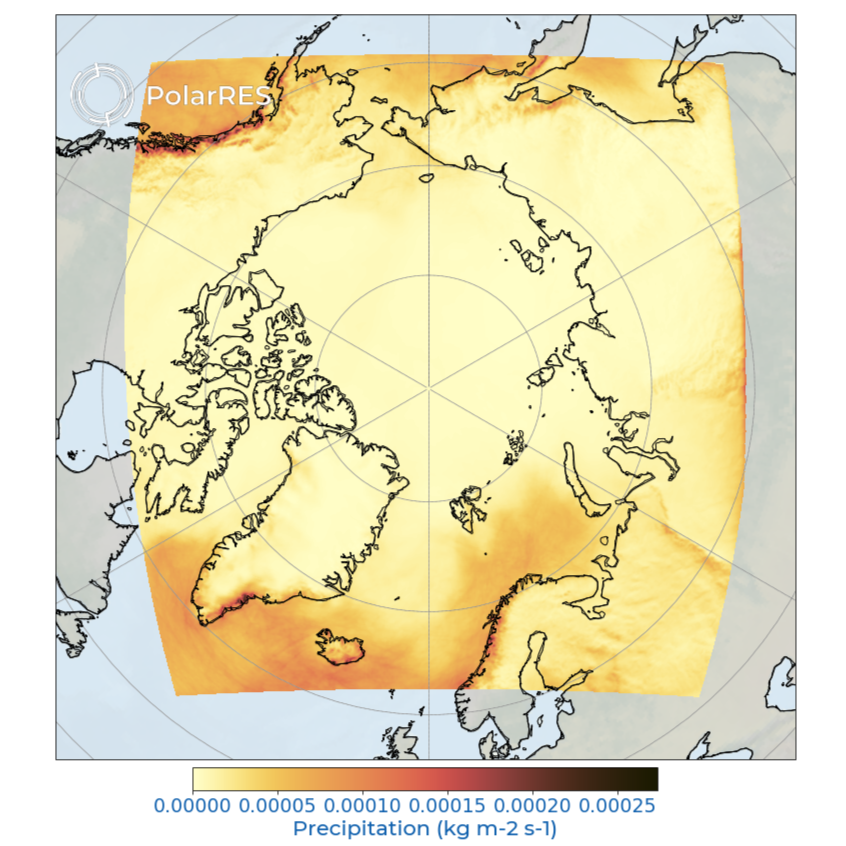
The Polar Storyline Lens enables users to interact directly with the modelling results produced in PolarRES, comparing variables, models, scenarios and time periods to see how climate conditions may evolve in the Arctic and Antarctic. By presenting these projections through the storyline framework, the tool helps clarify how changes in large scale circulation patterns are linked to regional climate outcomes.